Microservices Platforms - part 4: Infrastructure services platform
This is the fourth in a series of articles based on my QCon San Francisco 2025 talk Microservices Platforms: When Team Topologies Meets Microservices Patterns. The articles in the series are:
- Microservices Platforms - part 1: Overview
- Microservices Platforms - part 2: Service foundation platform
- Microservices Platforms - part 3: Security platform
- Microservices Platforms - part 4: Infrastructure services platform
- Microservices Platforms - part 5: Observability platform
- Microservices Platforms - part 6: Build platform
In a microservice architecture, application services depend heavily on infrastructure services such as databases, message brokers, and cloud resources. Managing these services requires deep expertise, strong governance, and significant operational effort. Expecting stream-aligned teams to handle this complexity increases cognitive load and slows delivery.
The solution is not “more DevOps” or “teach every team Terraform.” It is to define an Infrastructure Services Platform owned by a dedicated platform group.
In this article, I describe what that platform is and how it enables stream-aligned teams to move fast without becoming infrastructure experts.
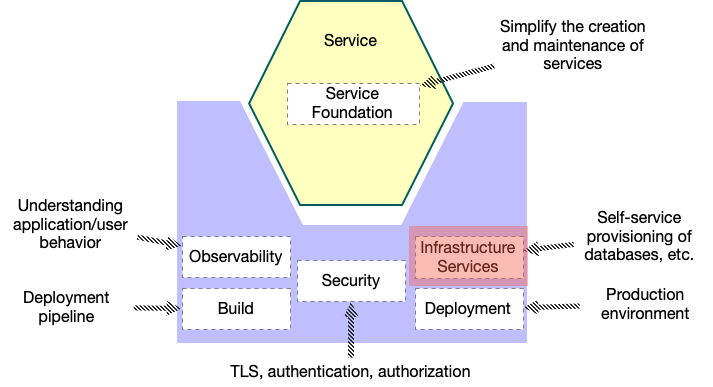
To understand why this platform is necessary, we must first examine the role of infrastructure services in a microservice architecture.